Independence Palace Ho Chi Minh City: Tickets, Hours & a Visiting Guide
For most first-time visitors to Ho Chi Minh City, the Independence Palace (Dinh Độc Lập) is one of the two or three sights worth clearing an afternoon for. It is the building where the Vietnam War reached its symbolic end on 30 April 1975 — and it is open to the public every day of the week, with its state rooms, private quarters and basement command bunker kept much as they were left. This guide gives you the current 2026 ticket prices and opening hours, a floor-by-floor look at what you will actually walk through, and a simple plan for folding the palace into a morning or afternoon in District 1.
🏦 Independence Palace at a Glance
Address: 135 Nam Ky Khoi Nghia, Ben Thanh Ward, Ho Chi Minh City (second entrance at 106 Nguyen Du)
Open: 07:00 – 18:00 daily, including weekends and Tet
General ticket (palace + exhibit): 80,000 VND for adults
Time needed: about 1.5 to 2 hours
Hotline: 0916 624 419
Tickets and Opening Hours in 2026
The current hours and prices took effect on 1 May 2026. There are two ticket tiers: a general ticket that covers the palace and the “From Norodom Palace to Independence Palace 1868–1966” exhibit, and a cheaper palace-only ticket. The general ticket is what most visitors want, because the exhibit is what makes sense of the building.
| Visitor |
General ticket (palace + exhibit) |
Palace only |
| Adult |
80,000 VND |
40,000 VND |
| Senior (60+) and Vietnamese university students |
40,000 VND |
20,000 VND |
| Child (6 to under 16) |
20,000 VND |
10,000 VND |
An optional electric-car tour of the grounds costs 25,000 VND per person per ride. Tickets are sold at the gate or can be booked in advance through the palace’s own online booking page (see the official links at the end of this guide).
The site has two gates, and the ticket offices keep different hours:
- 135 Nam Ky Khoi Nghia Street — ticket office open 07:00 to 18:00
- 106 Nguyen Du Street — ticket office open 08:00 to 16:00
Whichever gate you use, the visiting window itself is 07:00 to 18:00. If you plan to buy tickets in person at the Nguyen Du gate, arrive before 16:00. The palace is open every day of the week, including weekends and Tet, and closes only on special occasions, which are announced on the official site. One warning worth repeating: a lot of third-party guides, including some that rank well, still print 65,000 VND and an 08:00–16:30 window. Both are out of date — the figures above are the operator’s own current ones.
How Long to Spend, and the Best Time to Go
Allow about 1.5 to 2 hours for the palace and the exhibit together — the full two hours if you read the room labels and linger in the basement. Go at 07:00 when the gates open, or after 15:00: the middle of the day is the hottest and busiest stretch, and much of the walk-through is warm, with plenty of stairs. In the rainy season an afternoon downpour is a good reason to stay inside and work down through the floors.
What You Actually See, Floor by Floor
The building is a short climb from the ground floor to the rooftop, and it is worth taking in order rather than wandering.
- Ground-floor state rooms — the grand reception halls where the president received diplomats, still furnished in their original mid-century style, with chandeliers and lacquer work.
- Upper-floor private quarters — the president’s living and working rooms and a family dining room, leading out to the roof terrace.
- The war-situation room — the command room from which the last decisions of the Republic of Vietnam were taken.
- The basement bunker — the reinforced tunnel level below the palace, with its bank of communications equipment, telephones and maps.
- The rooftop and lawns — the helipad on the roof, and, on the grounds, the tanks that crashed through the gates on 30 April 1975.
If you are short on time, the route above is the one to prioritise — and whatever else you skip, do not skip the basement.
From Norodom Palace to Independence Palace: the Short History
The general ticket includes the exhibit “From Norodom Palace to Independence Palace 1868–1966”, which tells the story of the site you are standing on. In short:
- 1868 — the French Governor of Cochinchina, La Grandière, lays the first stone of Norodom Palace on a site of about 12 hectares; it is completed in 1871.
- 1887 to 1945 — the palace serves as the headquarters of the Governors-General of French Indochina, until Japanese forces take control on 9 March 1945.
- 1954 — after the Geneva Accords, it is transferred to the State of Vietnam on 7 September and renamed Independence Palace the next day.
- 1962 — badly damaged in the 27 February bombing and demolished; the present building is built to architect Ngô Viết Thụ’s design, starting 1 July 1962.
- 1966 — the new Independence Palace is inaugurated on 31 October, under Nguyễn Văn Thiệu.
- 1975 — on 30 April, tanks break through the gates and the National Liberation Front flag is raised on the roof at 11:30 a.m., ending the war.
The palace was recognised as a National Historical and Cultural Relic in 1976 and as a Special National Monument in 2009 — the context the exhibit sets out in detail, and the reason the general ticket is worth the small extra over the palace-only tier.
Getting There
The palace sits on Nam Ky Khoi Nghia in District 1, on the northern edge of the Ben Thanh area, a short walk from both the War Remnants Museum side of town and the city centre. From most District 1 hotels it is an easy 10 to 20 minute walk, or a short Grab ride. There are two usable gates: the main entrance at 135 Nam Ky Khoi Nghia, and the second at 106 Nguyen Du, which is the more convenient of the two if you are arriving from the Notre-Dame Cathedral side. Public buses run along Nam Ky Khoi Nghia and the streets behind Ben Thanh Market; see our Ho Chi Minh City transport guide for how to use them.
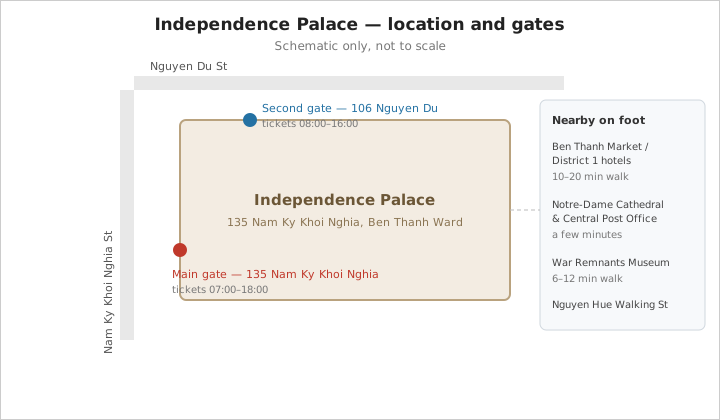
Schematic only, not to scale. Walking times are estimates from the palace gates.
|
Pair It With: a District 1 Walking Cluster
Allow two to three hours for a simple, flat circuit that starts and ends around the palace:
Independence Palace → Notre-Dame Cathedral Basilica (exterior) → Saigon Central Post Office → Nguyen Hue Walking Street and the riverfront.
Note that the cathedral has been under restoration for several years, so check its current status before planning to go inside; the post office opposite is the easier quick stop. For more on the neighbourhood, see our District 1 guide and District 3 guide, and if you are planning a fuller day around the city, our two- to three-day Ho Chi Minh City itinerary builds the palace in as a stop. Staying central? Our guide to hotels near Ben Thanh Market covers the walkable options, and the main attractions page lists what else is nearby.
Practical Tips
- Buy before you go. Tickets are available at the gate, but booking online through the palace’s own page saves queuing at peak times.
- Wear light clothing. Much of the walk-through is warm and involves stairs; there is limited shade on the grounds.
- Check photography rules. The palace publishes official photography regulations, so check the latest notice on the official site before any professional or commercial shoot.
- Check for closures the day before. The palace is also a working official venue, and closures for state events are announced on the official site.
- Plan for the basement. It is the highlight for most visitors and easy to miss if you are rushing — give it 20 to 30 minutes on its own.
- Want a preview? The palace also runs an official online virtual tour of the site if you like to know what you are walking into first.
Seen as a whole, the Independence Palace is less a museum of objects than a building left mid-conversation with its own history. Pair the exhibit with the rooms upstairs and the bunker below, and an hour and a half here will do more for your understanding of modern Vietnam than almost anything else in the city.
Official sources: dinhdoclap.gov.vn — visiting hours and ticket prices | dinhdoclap.gov.vn — history of the Independence Palace | visithcmc.vn — Independence Palace. Prices and hours are those published by the operator and were valid from 1 May 2026.
|
